
Distribute yield with Merkl
How to redirect your reserve-generated yield to DeFi users without depleting your treasuryDistribute reserves-generated yield with Merkl
Stablecoin issuers sit on reserves that natively generate yield, a self-renewing budget that can be deployed to grow the stablecoin's footprint across DeFi without drawing on other resources.
Merkl is a natural place for stablecoin issuers to distribute their net interest margin (the spread between what their reserves earn and what they retain) to select DeFi users and venues that hold the token. The goal is to offer deep, sustainable yield products to users across the venues that matter for stablecoin growth, without overpaying or being gamed by advanced users. Merkl offers several mechanisms to do this with strict spend discipline, each with a different trade-off between cost control and end-user experience:
- Idle liquidity-based rewards: tight cost control. You never pay more than what you earn on the target venue (or at least you calibrate it so spend stays bounded by your net interest margin).
- Total APR campaigns: better UX. You guarantee end users a target total APR on a venue, at the cost of losing strict control over spend relative to what you earn there.
Together, these turn passive reserve income into a sustainable engine for stablecoin growth, backing deep yield products for users wherever the token is held.
Mechanism 1: Idle liquidity-based rewards
Idle liquidity-based rewards are a capital-efficient mechanism that rewards depositors proportionally to unutilized liquidity. The core guarantee: you never spend more than what you earn on the target venue, or at the very least you calibrate the target APR so spend stays bounded by the net interest margin generated there.
How It Works
This feature creates a self-balancing incentive system where your reward costs scale automatically with market conditions:
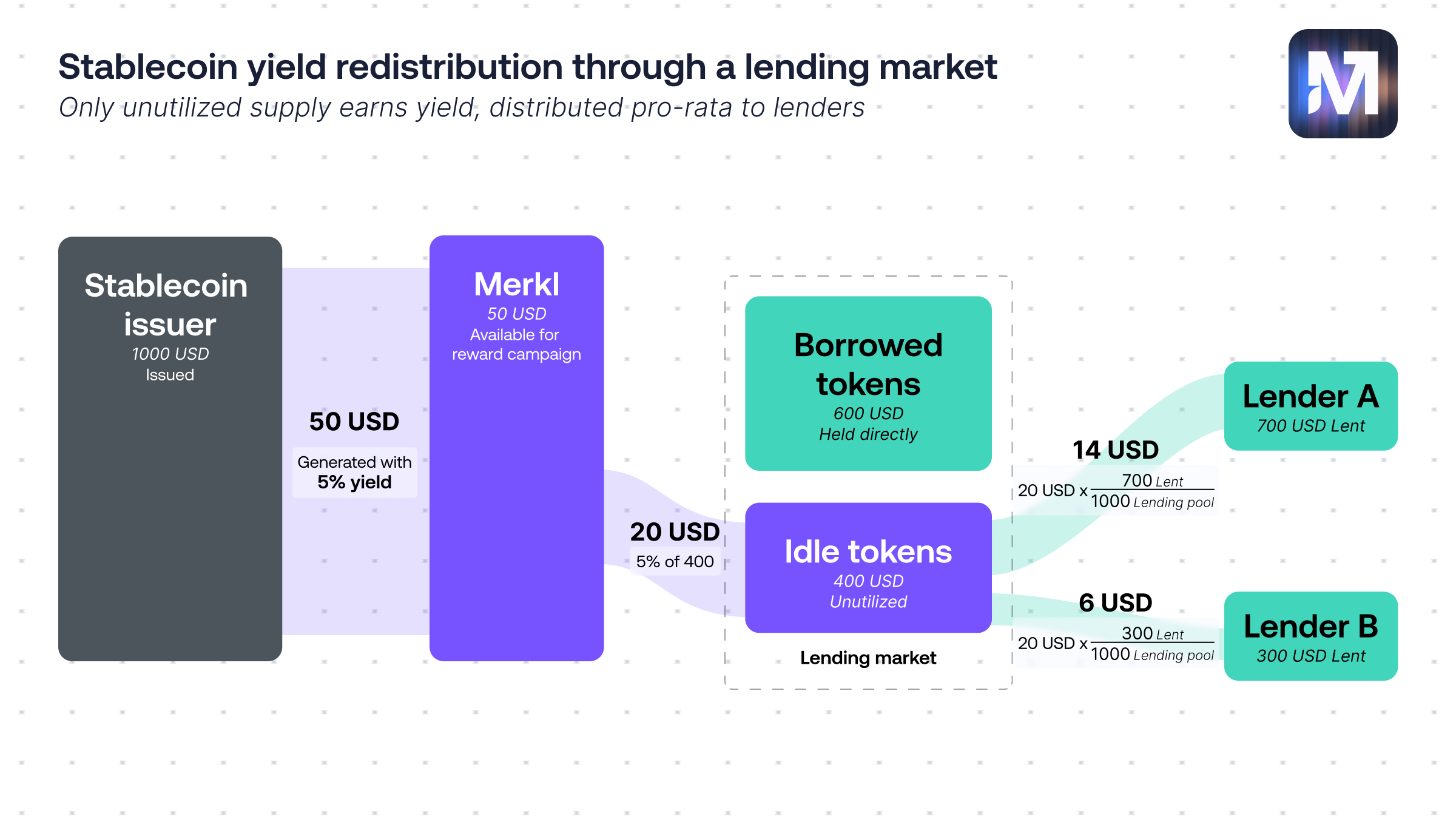
- Fixed APR on Idle Capital: You specify a target APR (e.g., 5%) paid on the unborrowed balance sitting in the target venue. This target APR corresponds to the APR you generate on your reserves, net of performance fees.
- Automatic Forwarding: These rewards are distributed proportionally to all depositors, even when they access the venue through vaults or other 3rd party apps.
Setup: Token Holding campaign
Idle liquidity-based rewards are set up on Merkl as a Token Holding campaign. You whitelist the contract addresses of the lending venues holding your stablecoin, and Merkl tracks the time-weighted balances of your stablecoin across all whitelisted addresses.
That balance is the true onchain metric of utilization: the higher the utilization on a venue, the lower the idle balance sitting in its contract, and therefore the lower the reward Merkl pays out on that venue.
As a concrete example, assume 100 tokens of your stablecoin are supplied to a lending venue, utilization is 25%, and the target APR is 5%. The idle balance Merkl observes on that contract is 75 tokens, so the campaign pays 5% × 75 over the observed period, distributed to that venue's depositors. If utilization rose to 100%, the observed idle balance would be 0 and nothing would be paid.
Because Merkl is accurate down to the block, balances are monitored continuously and rewards are computed on a time-weighted basis, so depositors are paid exactly for the idle liquidity they provided, for as long as they provided it.
Use the following template in Merkl Studio to create such campaign in a couple of minutes.
Key Benefits
- Cost Control: You only pay when capital is unutilized. High utilization means minimal incentive costs but maximum borrow fee revenue
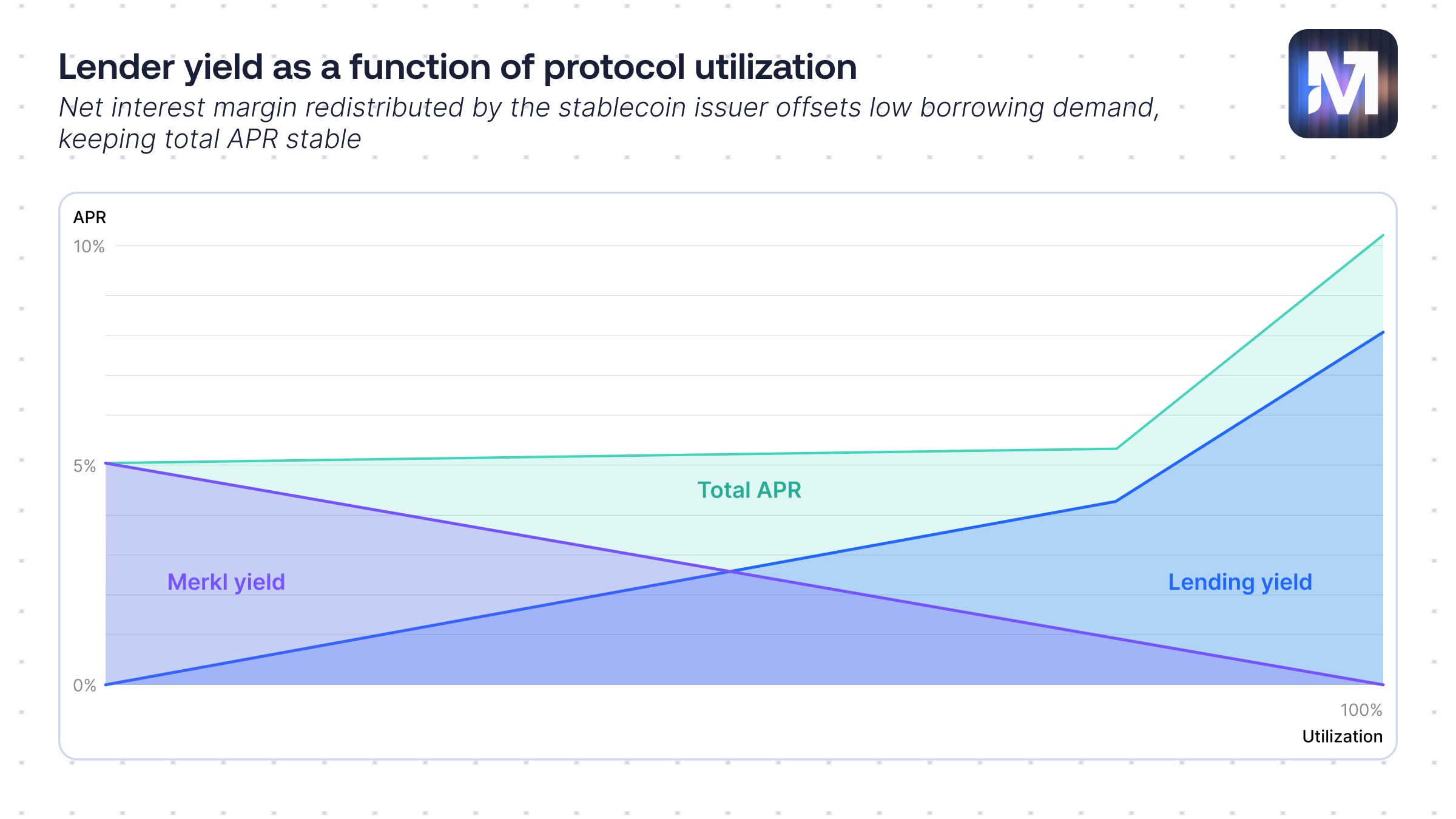
- Natural Equilibrium: When utilization is low, depositors receive rewards close to the reserve rate, improving overall APY and attracting deposits
- Self-Funding: Incentives are funded directly from the reserves generated by idle capital, creating a sustainable model
Market Dynamics
High Utilization
- Minimal idle capital. Very low incentive costs
- High borrow fees generated. Depositors earn primarily from organic borrowing activity
Low Utilization
- Significant idle capital. Higher incentive payments, but a lot of idle assets are sitting in the venue, so the cost is partially or completely paid by the yield generated on the reserves
- Lower borrow fees. Depositors receive substantial rewards from idle liquidity, keeping APY competitive
Supported venues
Idle liquidity-based rewards are venue-agnostic. Merkl applies them to any lending venue where utilization and depositor balances can be tracked onchain. Aave and Morpho are two current integrations described below as examples, and more venues can be added as the stablecoin is integrated into them.
- Aave: the aToken contract holds all of the pool's unborrowed liquidity, so you only need to whitelist this single contract. Merkl rewards each depositor on their pro-rata share of the pool's net lending balance (what has been supplied minus what has been borrowed), which is exactly the idle liquidity they are providing at any moment.
- Morpho: every market runs under a single singleton contract, which is the one you whitelist. Merkl iterates through every market that uses your token, reading each one's utilization, and rewards depositors proportionally to the idle balance they contribute to that market. Rewards are automatically forwarded down through the layers of vaults that deposit into those markets, so end users always receive their share. A market at 100% utilization pays nothing to its suppliers. When the stablecoin is used as collateral on Morpho rather than supplied for lending, users are rewarded based on the amount of collateral they have posted.
Mechanism 2: Total APR campaigns
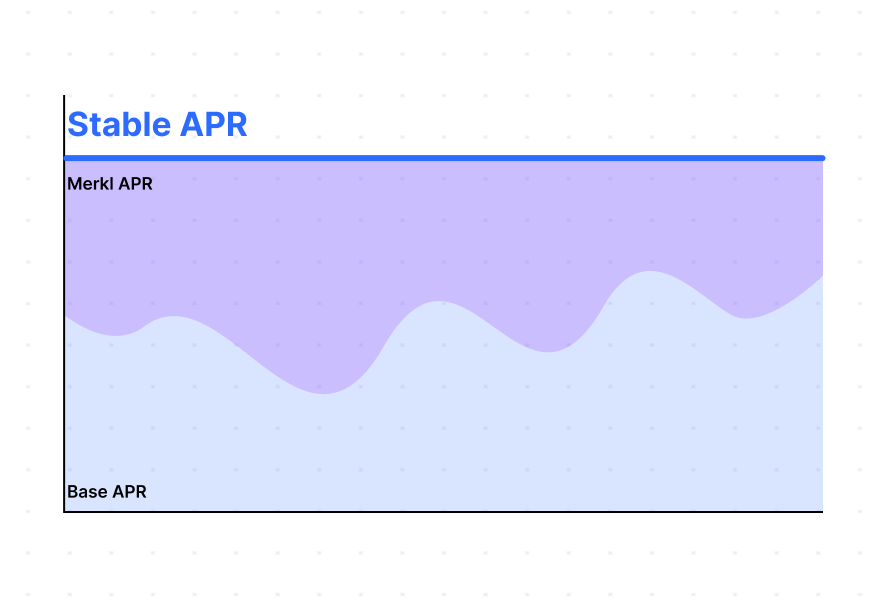
Total APR campaigns let issuers guarantee a target total APR to end users on a given lending venue. Merkl continuously measures the native yield earned by depositors there and pays out the difference between that native yield and the target APR you set.
This gives depositors a predictable, advertised APR regardless of market conditions. Great for user experience and marketing, with an important trade-off:
- No strict spend cap vs. earnings: unlike idle-liquidity campaigns, you do not strictly control how much you pay relative to what you earn on that specific venue. If utilization or native rates move against you, top-ups can exceed the net interest margin generated there.
- Predictability for users: in exchange, depositors always see the APR you advertised, which can materially increase deposits and strengthen the stablecoin's footprint.
Total APR campaigns are the right choice when predictable end-user APR matters more than strict cost control, and when you are comfortable monitoring the campaign to keep overall spend in line with reserve earnings.
Merkl supports Total APR campaigns on multiple lending venues. See the Merkl docs on Target Total APR campaigns for the full list and technical details.
Compliance considerations
Merkl provides the infrastructure to distribute yield, but it is not legal advice. Redistributing reserve-generated yield to stablecoin holders or DeFi users may fall under evolving regulatory frameworks, including the GENIUS Act (US payment stablecoins) and the CLARITY Act (US digital asset market structure), as well as equivalent regimes in other jurisdictions.
Issuers are responsible for structuring their distribution programs to be compliant with the rules that apply to them, and should consult their own counsel before launching a yield-redistribution campaign on Merkl.
To help with this, Merkl also supports activity-based rewards, where payouts are tied to specific onchain actions (borrowing, swapping, bridging, providing liquidity, etc.) rather than passive holdings. This can be a useful building block when structuring a compliant distribution program, since activity-based rebates are typically treated differently from passive yield under the frameworks above.
Related Guides

Redistribute stablecoin yield with one simple, flexible setup
Redistribute your stablecoin's reserve yield onchain to the users, venues, and partners that drive its usage, with one setup you fully control.