What budget should you set for your campaign?
How to size your reward budget, benchmark APRs, and iterate toward an efficient incentive campaign on MerklOverview
The ideal campaign budget depends on your specific objectives and the distribution method you choose. Campaign budgets follow a natural supply-and-demand dynamic: liquidity providers want to maximize their rewards, while campaign creators aim to minimize costs. As a result, TVL typically scales proportionally with the reward budget you allocate.
Account for fees
Depending on your campaign type, you need to account for fees differently. See the fees section in the Merkl docs for details on how fees apply to your specific campaign type before finalizing your budget.
Choose the right distribution method
If you're concerned about over-distributing rewards early in your campaign, consider using a capped APR campaign. This approach ensures you don't exhaust your budget too quickly if TVL starts low: rewards are distributed at a fixed rate relative to TVL rather than depleting a fixed token amount.
Benchmark APRs
To gauge appropriate reward levels, you can:
- Browse existing campaigns on the Merkl app to see typical APRs in your category
- Use Merkl's APR simulator to model how different reward budgets translate to APRs at various TVL levels
- Adjust your budget based on competitive rates and your growth targets
Start small, iterate often
We recommend launching shorter campaigns initially (e.g., 2 weeks) to test performance and gather data. You can then create follow-up campaigns with optimized parameters based on actual TVL, user engagement, and APR effectiveness.
This iterative approach minimizes risk and maximizes ROI.
Related Guides
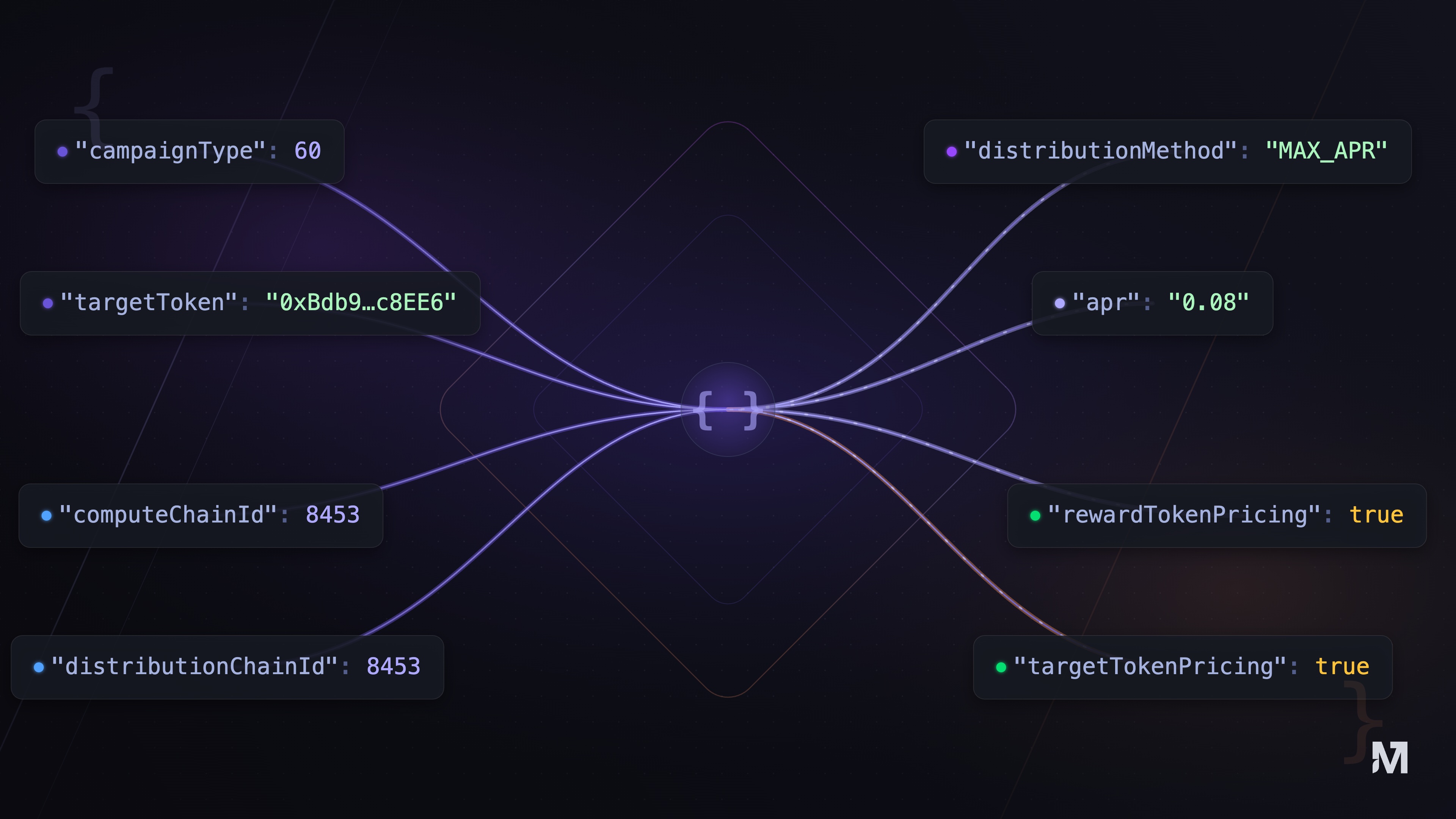
How a Merkl campaign is built: understanding the configuration
Learn how every Merkl campaign is built from a configuration, with its two layers: standard fields and structured inputs, explained simply.
Keep custody of your tokens with token wrappers
Run Merkl campaigns without ever transferring your reward tokens — Merkl is just the distribution infrastructure, you stay in control of the funds