
Redistribute stablecoin yield with one simple, flexible setup
Sharing part of your reserve yield is one of the strongest ways to grow a stablecoin. The hard part has always been doing it onchain: reaching the right venues and partners, adjusting the rate as your yield moves, and updating the list of beneficiaries as it changes, without rebuilding your setup each time. Merkl makes it one simple, flexible setup.
Turn reserve yield into onchain growth
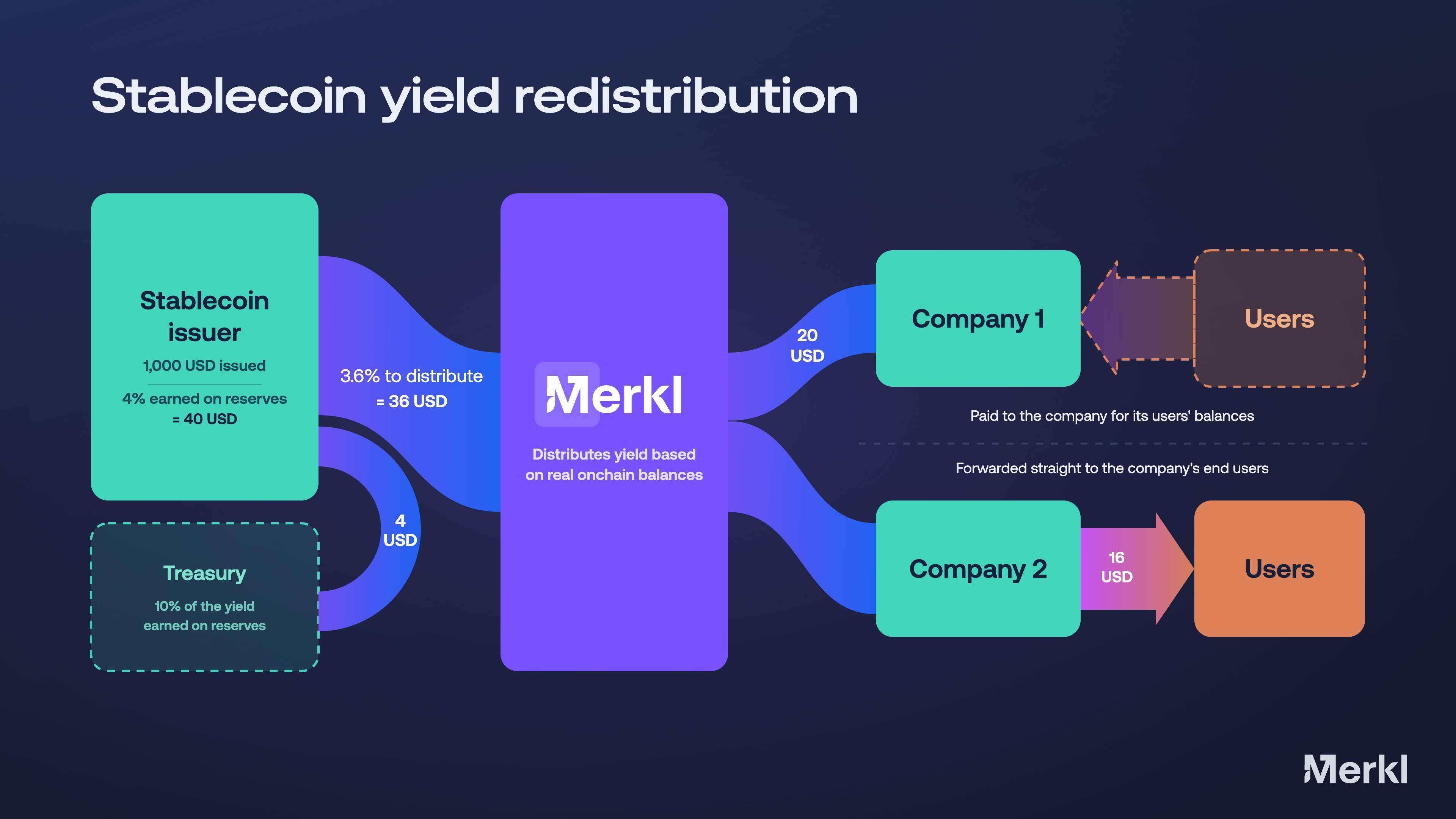
Stablecoin reserves, usually made up of treasury bills, generate yield. After costs, that yield is your net interest margin (NIM), and you can share part of it with those who actively use your stablecoin, from individual users to the companies that drive its usage.
You decide how the payout is structured, tied to onchain activity rather than to passive holding, or routed to a dedicated company wallet, so you can keep it compliant with whatever framework applies to you, from GENIUS to MiCA to CLARITY.
Distribute it through Merkl
Once you have set aside the cut you want, Merkl distributes the rest for you. As the paying agent of onchain finance, Merkl handles the whole distribution across any DeFi venue, without a line of code, and keeps you in control at every step. You never distribute more than your reserves earn.
Keep custody of the budget
You keep custody throughout. Merkl uses a push model, so payouts go straight from your wallet to user wallets and funds never sit with a third party. If a payout is ever assigned to an address that cannot claim it, you can recover those funds.
Run it with near-zero maintenance
The only recurring task is funding. You top up a single address with the yield you plan to distribute, and there is nothing else to maintain.
Adjust your rate automatically
Your payout rate can be whatever you want, a fixed value or a function of any inputs you choose. Merkl can track offchain references like the Secured Overnight Financing Rate (SOFR), or any other source, and make your rate follow them in real time, with no manual updates.
Control who earns, anytime
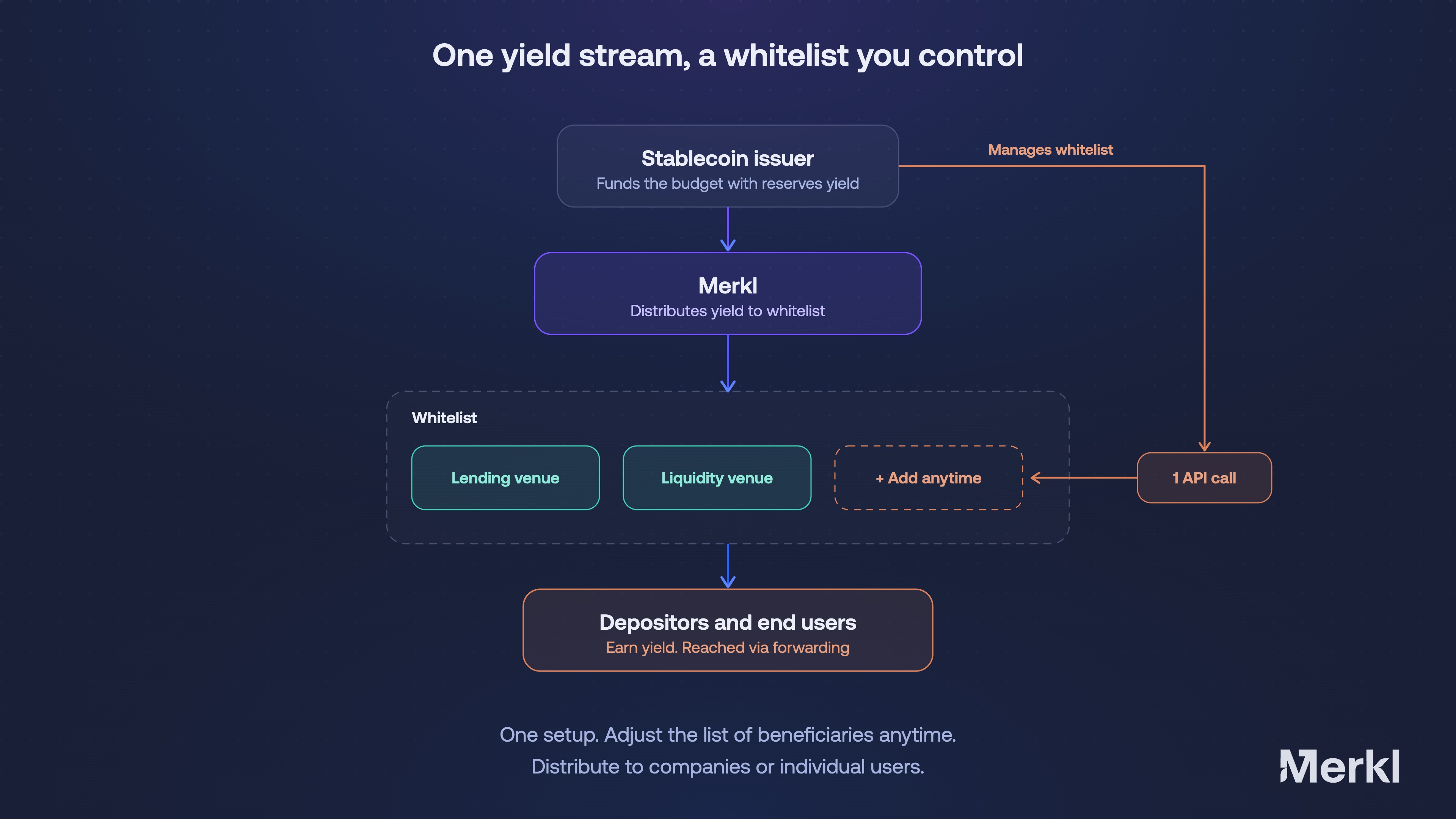
Once your distribution is set up, eligibility can be governed by a whitelist that you update programmatically.
Adding or removing an address takes a single API call, with nothing to sign or redeploy onchain.
This works at scale. Your distribution keeps running while your whitelist evolves underneath it, so the set of addresses earning your yield can grow or shrink at any time without touching the underlying setup.
Whitelist a protocol, not a thousand addresses
You do not have to enumerate every recipient. You can whitelist at the protocol level.
Whitelist a lending protocol's contract, and distribution flows automatically to every market that holds your token under it, thanks to Merkl's reward forwarding. Forwarding traces ownership through the layers of nested contracts that sit between depositors and the underlying lending markets, so every reward lands in the wallet of the actual end user rather than getting stuck at an intermediary vault contract.
For example, whitelist the Morpho contract, and every user who deposited your stablecoin through a Morpho vault becomes eligible.
The result: one call to widen your program to an entire protocol.
Reward a company for its users' balances
Forwarding sends a reward down to the end users behind a contract. Merkl can also do the reverse. It aggregates the balances held by a company's users and rewards the company itself, in proportion to how much its user base contributes to your stablecoin's circulation.
To do this, Merkl maps wallets to the entities behind them, so you always know which wallets belong to which company or partner. Attribution and reconciliation across many partners are handled for you, at scale.
Pay each contributor their exact share
Merkl does not rely on snapshots. It reads every onchain event and tracks balances continuously, so each recipient earns exactly in proportion to what they contributed, for exactly as long as they contributed it.
On any venue, rewards scale with real balances. As a position grows or shrinks, its share adjusts automatically, so you always pay for actual contribution, never a stale snapshot. On a lending market, Merkl pays only on the part that isn't already earning interest from borrowers.
Concrete examples
DeFi venue expansion
Say you issue a stablecoin and start distributing your reserve yield to depositors on Morpho. Tomorrow, Aave lists your stablecoin. Expanding your program is one API call: whitelist the Aave contract, and Aave depositors become eligible. The distribution was already running, so the cost of expansion is zero.
Multiple liquidity pools
Your stablecoin trades across many Uniswap pools. Rather than pick one, you whitelist several at once, and the liquidity providers in each become eligible. As liquidity moves to new pools, you add them the same way, one call each, all drawing from the same budget.
KYC-cleared beneficiaries
Share yield only with beneficiaries who cleared your checks. As more of them pass KYC, you add each to the whitelist, and the program widens to every new verified participant without touching the setup.
Distribution partners
You can also reward the companies that grow your stablecoin's usage, not just their end users. Say a partner brings 100,000 user wallets. Merkl tracks the balance those wallets hold over time and rewards the partner's own address in proportion. Your distribution network becomes an incentive of its own.
Conclusion
Sharing your reserve yield should not mean rebuilding your setup every time your program changes. You set it up once, keep custody of the budget, adjust the rate as your margin moves, and decide who earns with a single API call.
You bring the yield. Merkl, the paying agent of onchain finance, handles the distribution and keeps it running as your program grows across every venue and partner that drives your stablecoin forward. Every payout lands with the right party, in exact proportion to what they contributed.
Related Guides

Distribute yield with Merkl
How to redirect your reserve-generated yield to DeFi users without depleting your treasury